a visit with jesus

 Jesus' Apostles

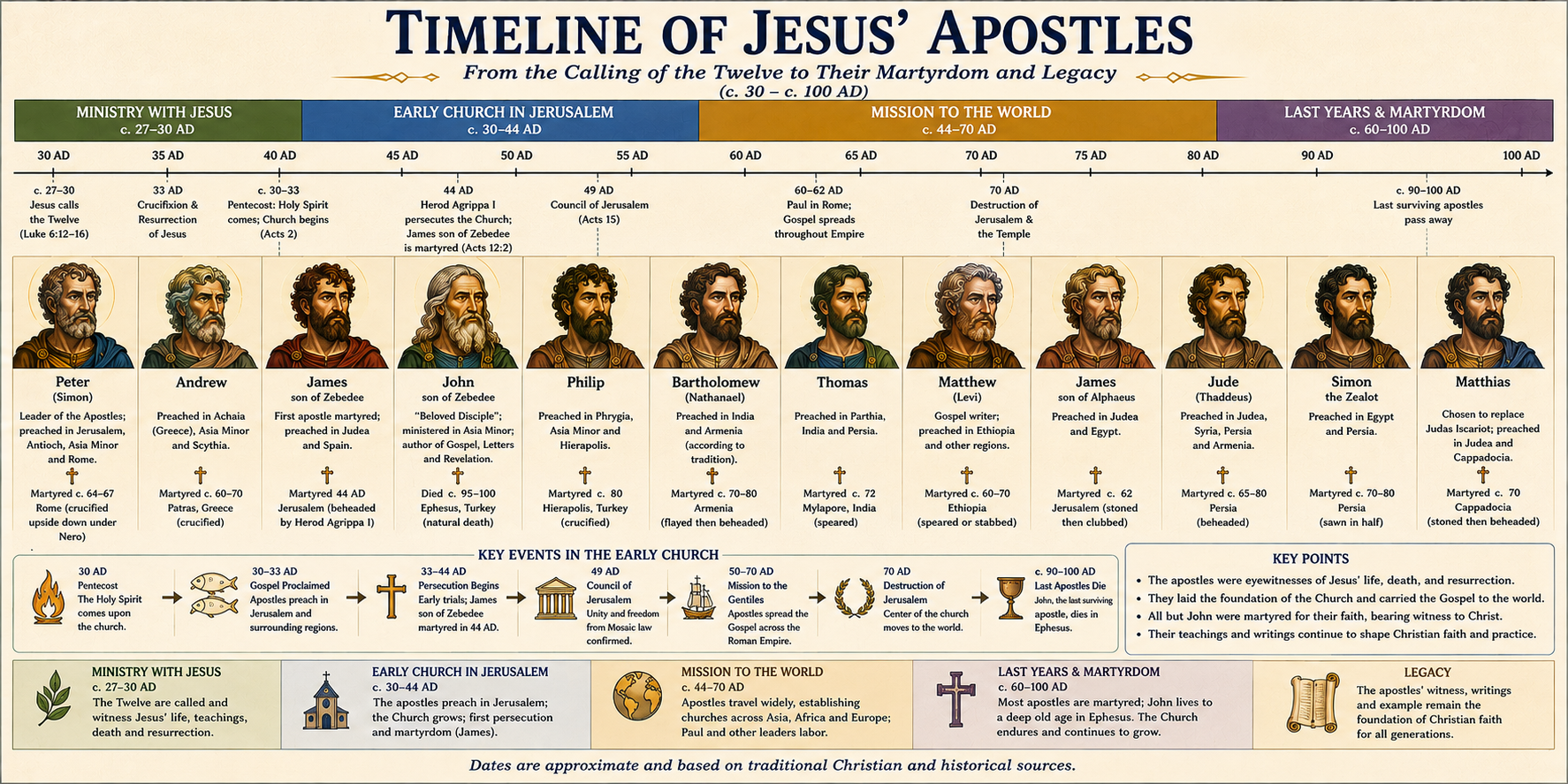
    (Click graphic for Timeline)
Clear Search

Thomas

"Doubting Thomas"

Thomas famously doubted the resurrection of Jesus and told the other disciples, “Unless I see the nail marks in his hands and put my finger where the nails were, and put my hand into his side, I will not believe” (John 20:25).

the Bible tells us little about him but Thomas’ cautious approach laid the foundation for evidence-based faith and for the Protestant teaching of sola fide, or faith alone.

Thomas wasn’t actually given a name in the original manuscripts. The name comes from the Aramaic word tĕʾomâ, which means “twin.” To help clarify who we’re talking about though, most manuscripts include the description, “called Didymus” or “called the Twin.”

Matthew

Levi

Matthew, also known as Levi, was a tax collector—one of the most reviled professions in first-century Judaism. As a tax collector (or publican), Matthew collected taxes for Rome from his fellow Jews in Capernaum. Tax collectors made their money by claining people owed Caesar more than they did and then skimming the extra off the top. As a result, they were considered sinners.

Now Mark and Luke call this tax collector Levi or Levi son of Alphaeus. Since these are parallel passages, and Levi is never referred to again, and Mark and Luke both include Matthew in the lists of apostles, it is assumed that Matthew and Levi are one in the same. While “Levi” may have referred to the tribe from which Matthew came, but it’s also possible that he had a Greek name (Matthew) and a Hebrew name (Levi), similar to how Paul was also known as Saul. Since Matthew/Levi was a Jew employed by Rome, that wouldn’t be surprising.

James

James, son of Alphaeus

James son of Alphaeus is only mentioned in the four lists of apostles. Little else is said about him. Questions do surround James son of Alphaeus, with some assuming he is the same person as one or two of the other Jameses in the New Testament.

While he is obviously not the same person as James son of Zebedee (also known as James the Greater), there are two other Jameses mentioned in the New Testament: James the Less ; James, brother of Jesus .

The early church assumed both of these Jameses were all the same person as James son of Alphaeus.

Jude

Thaddeus or Lebbaeus

Jude the apostle is also known as Jude of James, Thaddeus, Judas Thaddeus, and Lebbaeus. Some believe him to be Jesus’ brother Jude, the traditional author of the Epistle of Jude, but the Bible doesn’t tell us. This may be unlikely, given that scripture says that Jesus' brothers didn;t believe in his mission, even after he had chosen his disciples. ( John 7:3-5)

In two of the lists of apostles, Jude appears to be referred to as Thaddeus. Since these two names appear in about the same place in the lists, and the other names are consistent, most modern scholars have assumed Thaddeus was a nickname for Jude of James.

Simon

Simon the zealot

Simon the Zealot may have belonged to a Jewish sect known as the Zealots, who sought revolution and were looking for a Messiah to violently overthrow Rome. However, he may have simply been zealous for the Mosaic Law or zealous for Jesus and his teachings.

Tradition claims he preached in Egypt partnered with Judas, the brother of Jesus.

Judas Iscariot

Judas Iscariot is one of the most widely known disciples. He infamously betrayed Jesus for 30 pieces of silver, which led to Jesus’ death on the cross.

Judas appears in several New Testament stories, and while the Gospel writers are in unanimous agreement that he betrayed Jesus, they present various takes on his motives. Judas Iscariot may have been considered “good with money” or trustworthy, since he wound up being in control of the money bag for Jesus and his disciples. Ironically, the first passage that tells of this also reports that he was completely untrustworthy.